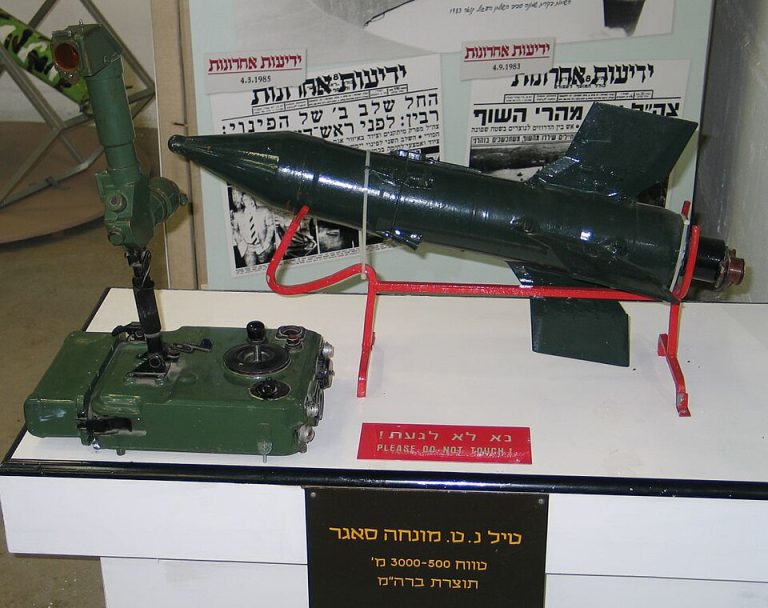
The former Fox News host, Tucker Carlson, appears to have been the target of an assassination attempt when he was visiting Moscow to interview Russia’s President, Vladimir Putin. The claim was made by Today News Africa that Ukrainian operatives attempted to attach a bomb to Tucker Carlson’s vehicle, hoping to detonate it when Tucker got in.
The report claimed “A man has just been arrested in Moscow, accused of being paid by Ukrainian intelligence to plant an explosive device on Tucker Carlson’s vehicle and assassinate the prominent American journalist while he was there to interview Putin.”
A new report claims that a native Russian has been arrested for the attempted assassination of Tucker Carlson, a former Fox News host who traveled to Moscow earlier this month to interview Russian President Vladimir Putin. The report also claims that Ukraine’s Main Directorate of Intelligence offered to pay the man $4,000.
In a Monday afternoon post on X, formerly Twitter, Simon Ateba, the chief White House correspondent for Today News Africa, wrote, “A man has just been arrested in Moscow, accused of being paid by Ukrainian intelligence to plant an explosive device on Tucker Carlson’s vehicle and assassinate the prominent American journalist while he was there to interview Putin.”
After Hungary announced plans to approve Sweden’s membership into NATO, the only thing that stands in their way is their own commitment to see the process through to the end. Sweden’s PM Ulf Kristersson referred to the decision by Hungary as an “historic day,” while also rejecting France’s call to potentially send NATO troops to Ukraine to fight Russia.
Sweden’s prime minister has ruled out sending troops to Ukraine for now – saying the subject is “not relevant at all” – putting down a clear marker between himself and Emmanuel Macron as he prepares for his historically neutral country to imminently join Nato.
Ulf Kristersson, who on Monday hailed a “historic day” as Sweden’s Nato membership was finally approved by Hungary, clearing the Nordic country’s path to join the western military alliance, said that while he respected “France’s will to help Ukraine”, Sweden would be following its own path.
Macron can discuss whether France will send troops to Ukraine, but not Nato, he said. “If a country sends troops somewhere else in the world it doesn’t affect Nato.”
France’s President Emmanuel Macron has stated that he will not rule out the use of Western troops to halt the Russian invasion of Ukraine, though other members of NATO expressed no interest in such a scenario.
Still, the introduction of the concept might be intended to either prepare the ground politically for such a move or to test the waters to see how the public reacts to such a scenario.
French President Emmanuel Macron said Monday that sending Western troops on the ground in Ukraine is not “ruled out” in the future after the issue was debated at a gathering of European leaders in Paris, as Russia’s full-scale invasion grinds into a third year.
The French leader said that “we will do everything needed so Russia cannot win the war” after the meeting of over 20 European heads of state and government and other Western officials.
“There’s no consensus today to send in an official, endorsed manner troops on the ground. But in terms of dynamics, nothing can be ruled out,” Macron said in a news conference at the Elysee presidential palace.
Macron declined to provide details about which nations were considering sending troops, saying he prefers to maintain some “strategic ambiguity.”
There are no plans for Western boots on the ground, multiple leaders have insisted
The UK, Poland, Czech Republic, Finland, and Sweden all spoke up on Tuesday against French President Emmanuel Macron’s suggestion that Western troops could be deployed to Ukraine.
While there was no consensus about sending ground forces, Macron said on Monday following a pro-Ukraine summit in Paris that “in terms of dynamics, we cannot exclude anything” in the conflict between Moscow and Kiev.
There are “no plans for NATO combat troops on the ground in Ukraine,” the secretary-general of the US-led bloc, Jens Stoltenberg, told AP in response to Macron’s remarks.
British Prime Minister Rishi Sunak did not rule out sending troops in principle, but his spokesperson told reporters that “beyond the small number of personnel in [the] country supporting the armed forces [of Ukraine], we do not have any plans to make a large-scale deployment.”
AT&T is claiming the massive phone outage on February 23rd that affected millions of calls, including 911 calls, was not caused by a cyber attack at all. Rather, they said, “we believe that today’s outage was caused by the application and execution of an incorrect process used as we were expanding our network, not a cyber-attack. We are continuing our assessment of today’s outage to ensure we keep delivering the service that our customers deserve.”
AT&T issued a statement Thursday night to explain that the telecom’s widespread network outage earlier in the day wasn’t caused by a cyberattack. Countless conspiracy theories emerged online Thursday morning as people naturally wondered why they’d lost service.
“Based on our initial review, we believe that today’s outage was caused by the application and execution of an incorrect process used as we were expanding our network, not a cyber attack,” AT&T said in a statement published to its website.
“We are continuing our assessment of today’s outage to ensure we keep delivering the service that our customers deserve,” the statement concluded without going into more detail.
Alexander Smirnov, the former FBI informant now charged for allegedly making false statements claiming President Joe Biden’s son Hunter took $5 million in bribes from the Ukrainian energy company Burisma, will be imprisoned before and during his trial
District Judge Otis Wright ordered Smirnov to be detained before and during his trial. The Judge all but accused the Defense Team of plotting to help Smirnov to get out of the country to evade charges, an accusation the defense vehemently denied.
Ex-FBI informant Alexander Smirnov will remain in jail while he awaits trial, a federal judge in California ruled Monday.
Smirnov also entered a not guilty plea during the hearing. He was indicted over allegedly lying about President Joe Biden’s family and their alleged dealings in Ukraine.
He is charged with lying to his FBI handler and falsifying documents.
Smirnov, a 43-year-old dual US-Israeli citizen, is accused of telling his handler that a Ukrainian energy company paid $5 million in bribes each to Biden and his son Hunter – an allegation that prosecutors say was a complete fabrication.
District Judge Otis Wright on Monday said that “there is nothing garden variety” about the criminal case involving Smirnov, who Wright says has a “habit or practice of making false statements.”
“I have not changed my mind,” Wright said. “The defendant will be remanded pending trial.”
In an open primary, that is a primary where Democrats can vote in the GOP primary, in the home state of South Carolina’s former Governor, Nicky Haley, Donald Trump secured another primary victory, beating the former South Carolina Governor 59 percent to 39 percent.
Haley responded to the crushing defeat claiming “I know 40% is not 50%. But I also know that 40% is not some tiny group,” discounting the fact that this was not a GOP primary, it was a South Carolina primary.
WHEN DOES the act of hoping against hope go from admirable to absurd? Not yet apparently for Nikki Haley, the last woman left standing against Donald Trump and his seizure of the Republican Party’s presidential nomination. You can forgive Ms Haley for persisting through losses in the early primary states of Iowa and New Hampshire. But the indignity suffered on February 24th—a 20-point walloping in the primary election in South Carolina, the state she was governor of for six years—should have proven fatal.
And yet even out of those grim statistics, Ms Haley managed to extract something hopeful: “Today in South Carolina, we’re getting 40% of the vote. That’s about what we got in New Hampshire. I’m an accountant. I know 40% is not 50%. But I also know that 40% is not some tiny group.” She vowed to carry on her campaign until at least March 5th, also known as Super Tuesday, at which point another 21 states and territories will have conducted their elections. The embers of optimism present today will, in all likelihood, be extinguished by then.
U.S. District Judge Lewis Kaplin has ordered Donald Trump to pay E. Jean Carroll $83 million from the lost defamation case against him, rejecting Trump’s request for a stay pending appeal. He has ordered the stay be considered only after the plaintiff, the largely discredited Carroll, has a “meaningful opportunity to be heard.”
U.S. District Court Judge Lewis Kaplan declined a request to grant a stay after a jury ordered Donald Trump to pay writer E. Jean Carroll over $83 million for defamation.
“Twenty-five days after the jury verdict in this case, and only shortly before the expiration of Rule 62’s automatic stay of enforcement of the judgment,” Kaplan noted. “Mr. Trump has moved for an ‘administrative stay’ of enforcement pending the filing and disposition of any post-trial motions he may file. He seeks that relief without posting any security.”
“The Court declines to grant any stay, much less an unsecured stay, without first having afforded plaintiff a meaningful opportunity to be heard,” the judge wrote in his one-page order.
Kaplan said Carroll must file a motion by Thursday. Trump will also have a chance to respond.
A U.S. Air Force airman set himself on fire outside of the Israeli Embassy in New York City in support of Hamas. The airman, 25-year-old Aaron Bushnell, livestreamed his suicide in support of Hamas on Twitch. He set himself on fire then cried out as he was dying, “Free Palestine.” He succumbed to his self-inflicted injuries in support of Hamas.
Almost a year ago, we briefly discussed the common hand grenades used by infantry and police around the world. These remain among the most common non-rifle weapons carried by soldiers around the world. While we have touched on this particular subject in passing in several articles, this week we are looking at the hand grenade’s ‘next level’: the Rifle Grenade.
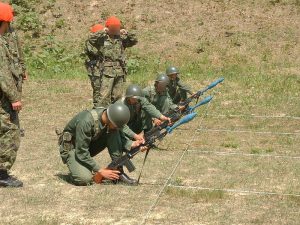
Japanese troops training with rifle grenades, c.2003. Photo Credit: Norseman5614. CCA/3.0
Since grenades came into widespread use in the mid-17th century, the weapon’s greatest detraction was its range. Limited to the strength and coordination of the thrower, hand grenades can only be used at very short ranges, typically within 50 yards/45 meters, at the most extreme range. While it is technically possible to throw a hand grenade farther, outside factors – extreme fear, fatigue, enemy fire, etc. – severely limit the throw range.
Coupled to this, in the early days, fuses were generally a piece of rope that had been soaked in a solution of saltpeter (KNO3) or gunpowder. Obviously, this did not make for a very reliable timing system in the field, where it was openly exposed to rain and mud…and other fluids. As a result, grenades faded from use in 1760’s, their memory kept alive by the units of European armies specially selected for use – the Grenadiers – who, due to their size and strength (the better, it was believed, to throw grenades farther) were converted into assault units, designated to assault an enemy position.
Private grenadier of the L.Gv. Preobrazhensky Regiment, 1700 to 1732. Painted c.1840. Unknown artist. Public Domain.
As World War 1 dawned, technology had advanced to the point where reliable timing fuses, protected from the environment, finally made hand grenades reliable enough to use; tactics, however, still had to catch up, as in 1900 the term “rifle company” meant precisely that – 100-120 men, equipped with rifles and bayonets, with only officers carrying pistols. New, and very expensive weapons like machine guns were actually considered to be light artillery (as their size and weight placed them on light carriages based on those for light cannons and howitzers). They and their heavier counterparts had to be assigned to an infantry unit separately. The PBI’s (“Poor, Bloody Infantry”) had to make do, and figure it out, otherwise.
But, as the horrors of full-scale trench warfare closed in along the Western Front, armies needed a way for the infantry to attack an entrenched enemy. Grenades were ideal, but they could only be used at very close range, and while the opposing trenches could occasionally get to within 100 yards of each other, that was still too far for the hand-thrown grenade.
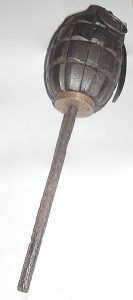
The British, German and Austrian solution to the problem was the “rod” grenade. This worked exactly how it sounds: a steel rod was attached to the bottom of a hand grenade that had been fitted with a longer fuse; the rod was inserted into the rifle’s muzzle and aimed, then the grenade’s safety ring was pulled out, and the grenadier pulled the trigger to fire a blank cartridge with no bullet in the case. The force of the gases from the firing shoved the grenade and its rod out of the rifle, and threw it 150-200 yards or so.
Mills bomb N°23 Mk I, with launching rod attacked. Photo credit: Jean-Louis Dubois, 2007. CCA/3.0
I can hear the groans and shrieks of terror and horror from all the shooters reading this from here.
The rod grenade – while it did work – severely damaged rifle barrels, to the point where a rifle would quickly become useless for anything else, as the stress of repeated firings warped the rifle barrels to the point where they could no longer fire accurately…assuming that they did not blow up in the firer’s face on the next launch.
In response, the British swiftly developed the “cup discharger”. This was a steel cup, just large enough to fit a hand grenade inside, that was clamped onto the muzzle of the rifle. A blank cartridge was loaded, and a hand grenade with a “gas check” plate welded to its bottom was slipped into the cup, and fired. While this system still placed heavy stress on the barrel from gas over-pressure, it was nowhere near as bad as the rods had been. Great Britain would continue to use this system through World War 2. Both Nazi Germany and Imperial Japan would use a similar system, although both of those combatants used rifled dischargers to add range and accuracy.
A member of the Home Guard demonstrates a rifle equipped with a cup discharger to fire an anti-tank grenade, Dorking, 3 August 1942. Imperial War Museum. Public Domain.
The French tackled the problem in a very…well, ‘French’ manner, with the “VB” grenade, named for its designers, Messer’s Viven and Bessières. This also used a special cup – in this case more like a cylinder, which clamped to the rifle’s muzzle. A specially designed grenade (quite different from a standard hand grenade) was slipped into the cup and aimed. The grenadier did not have to use a special blank round, though – the VB was activated and launched with a conventional bullet: When fired, the bullet exited the muzzle, deftly striking a lever inside the grenade, which activated the percussion cap to ignite the fuse. The action of the lever’s bottom end swing closed trapped the propellant gases coming up behind the bullet, and used them to throw the grenade clear of the discharger cup.
Photographs of a French V-B rifle grenade, a bullet trap type. Top shows views and cutaway of the grenade, bottom shows the grenade and grenade launcher, which is affixed to the rifle. Cross-section shows that the grenade is a pass-through design, allowing the use of live ammunition. Arming tab, activated by the bullet’s passage, can also be seen. US Government, c.1917-1918. Public Domain.
The VB worked very well, and solved the only real problem of the cup discharger, in dispensing with the blank cartridge. When the United States entered the war it, too, adopted the VB design, although it had to manufacture its own weapons, as American and French system and calibers were significantly different. The US would retain the VB design until the early stages of World War 2, using them as late as the 1942 Battle of Guadalcanal. In contrast, while the French military abandoned the VB after World War 2, their Gendarmerie would use the design to launch tear gas grenades into the 1990’s.
French riot police deploy tear gas, 2007. CCA/2.0
World War 2 Japan took a very different course, with their Type 100 Grenade Discharger. This device fired standard hand grenades from a cup fitted to the rifle muzzle, and that was launched using a standard rifle bullet. However, unlike the VB system, the Type 100 was offset from the muzzle, and used a gas tap from the firing to launch the grenade out to about 100 yards. This is not surprising, however, if one knows the history of Japan’s infamous “knee mortar”.
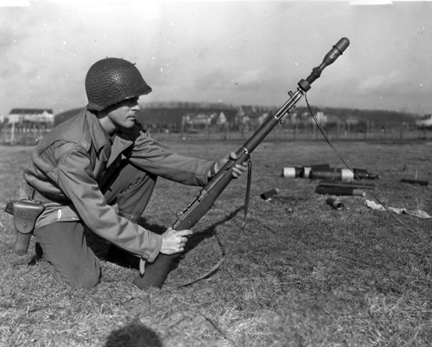
The United States led the way after World War 2, by adopting the “spigot” type of rifle grenade. This mounted a grenade on top of a tube with stabilizing fins, which slipped over the muzzle of the rifle, and was fired by a blank cartridge. This eliminated the need for a separate launcher, although still requiring a special cartridge. NATO would eventually standardize on a grenade with a mounting tube with an internal diameter of 22mm. This allows a common system for any standardized rifle to fire both blank cartridge, “shoot-through”/VB-type grenade and “bullet-trap” type grenades.
Advancements in materials technology would lead to the development of the “bullet-trap” design, allowing a rifle to fire a grenade with a regular cartridge; the rifle bullet would be captured by the bullet-trap on the grenade, using both the force of the cartridge’s gas and the physical force of the projectile’s impact to launch the grenade.
In the late 1950’s and early 1960’s, with the rise of the “intermediate cartridge”, the muzzle-launched rifle grenade began to fall out of favor, as the intermediate cartridges available lacked the energy to effectively launch the older grenades to the same ranges. The only solution was to shrink the size of the grenades. This led to rifle grenades being seen to be less effective than lightweight rocket launchers such as the M72 LAW. There was, however, a replacement that stepped in and took over: the 40mm Hi-Low Grenade.
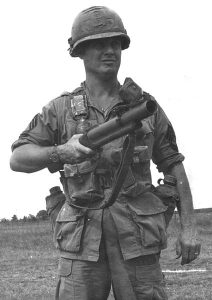
First deployed by the United States in 1961 with the adoption of the M79 grenade launcher and the later M203 system that could be easily mounted under the barrel of most military rifles, this system was so revolutionary, no established state military’s land warfare units lack some system firing a variation of the Hi-Low system.
MSG Claude L. Yocum, HHC, 2nd Bn., 1st Inf., 196th Lt. Inf. Bde., Vietnam. 1960’s. US Army photo. Public Domain.
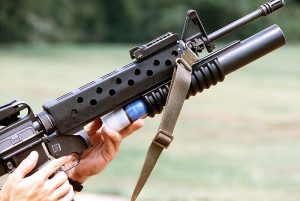
These weapons are able to launch grenades out to 200 to 400 yards (sometimes farther), which have a blast effect similar to a regular hand grenade, but that also fire a wider variety of grenades than the older models of rifle grenades.
A 40 mm practice round is loaded into an M203 grenade launcher mounted on an M16A1 rifle, 1988. US Air Force Photo. Public Domain.
Wars are always violent; expecting them to be “clean” or “surgical” is a fantasy. Weapons development is not evil, if the weapons make your forces more capable of ending a war faster, with as little destruction and savagery as possible.
As the legendary Chinese general Sun Tzu said in the opening lines of his military treatise, The Art of War, in c.500BC –
The art of war is of vital importance to the state.
It is a matter of life and death, a road either to safety or to ruin. Hence under no circumstances can it be neglected.
The Freedomist — Keeping Watch, So You Don’t Have To
In 2019, a Virginia Jury awarded record companies $1 billion after finding Cox Communications’ customers guilty of committing 10,000 copyright violations. The ruling was overturned by the 4th Circuit Federal Appeals Court, which said the award was excessive and warranted a new trial to determine what the right amount should be.
Cox Communications, the cable television and internet service provider, convinced a U.S. appeals court to throw out a $1 billion jury verdict in favor of several major record labels that had accused it of failing to curb user piracy, setting the stage for a new trial on the matter.
The 4th U.S. Circuit Court of Appeals in Richmond, Virginia, ruled on Tuesday that the amount of damages was not justified and that a federal district court should hold a new trial to determine the appropriate amount.
Back FREEDOM for only $4.95/month and help the Freedomist to fight the ongoing war on liberty and defeat the establishment's SHILL press!!
Are you enjoying our content? Help support our mission to reach every American with a message of freedom through virtue, liberty, and independence! Support our team of dedicated freedom builders for as little as $4.95/month! Back the Freedomist now! Click here